ABOUT
Buber Correspondence Digital Edition
The Dialogical Principle in Martin Buber’s Scholary and
Intellectual Networks in the 20th Century
Dialogical Encounters Through Letters
About the Project
Buber Correspondence Digital Edition (original German title: Buber-Korrespondenzen Digital. Das Dialogische Prinzip in Martin Bubers Gelehrten- und Intellektuellennetzwerken im 20. Jahrhundert, BKD) is a digital edition dedicated to the extensive and, until now, largely unedited correspondence of the religious philosopher Martin Buber (1878–1965). Buber was one of the foremost thinkers of modern German-Jewish intellectual and cultural life, and his thought continues to resonate internationally. Buber moved in intellectual, political, and artistic circles in the Austro-Hungarian Empire, particularly in Galicia and Vienna and participated in German cultural life during the Weimar Republic and under Nazi rule. From 1938 onward, he was part of Jerusalem’s German-Jewish émigré community. After World War II, his extensive network of scholars and intellectuals spanned Europe, Israel, and the United States. Maurice S. Friedman rightly described his life as »a life of dialogue«.
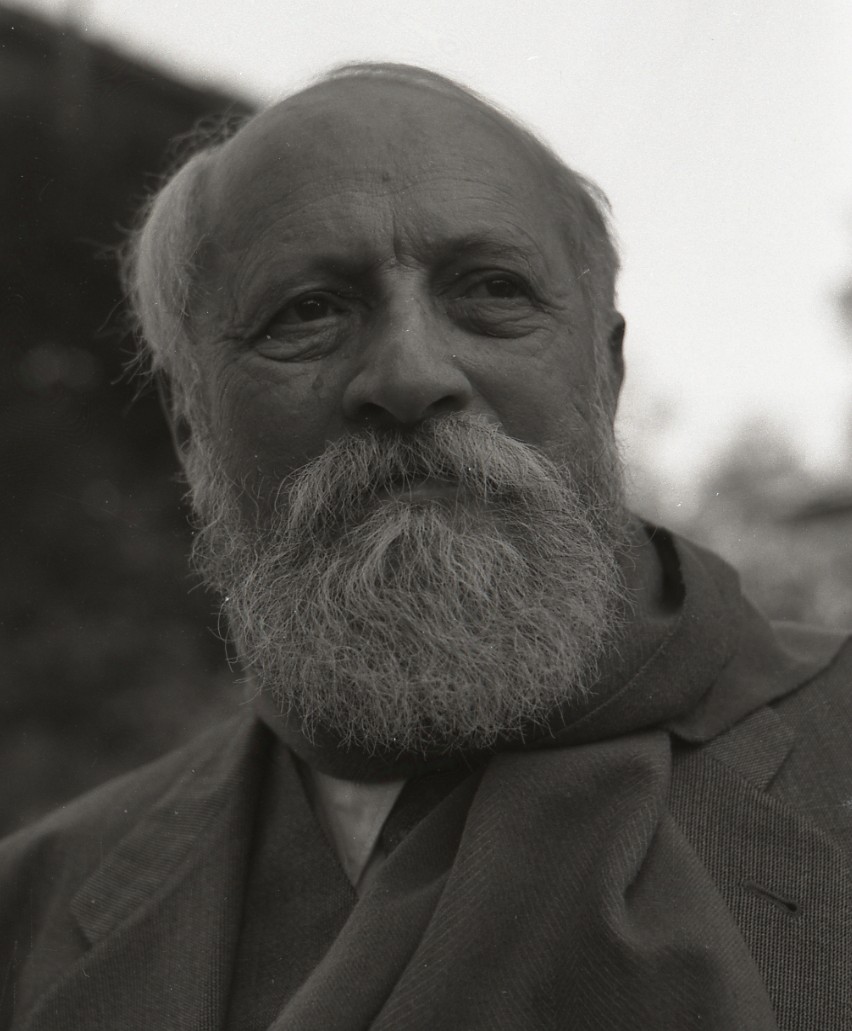
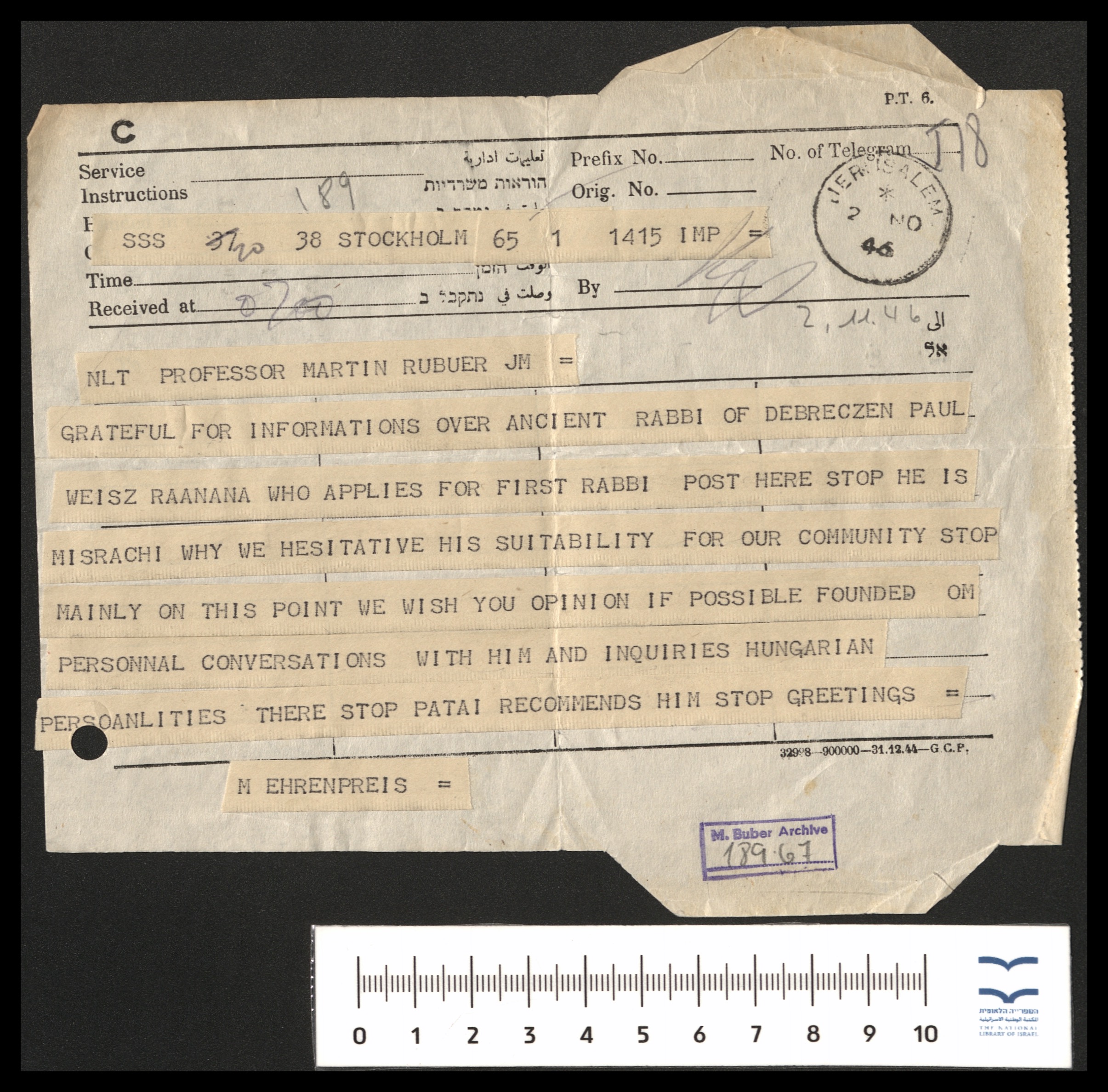
Buber’s transdisciplinary thought ranged across theology, philosophy, religious studies, literature, art, sociology, education, and psychology. He had extensive connections with numerous contemporary figures and institutions, both prominent and now largely forgotten. By cataloging and providing scholarly access materials from Buber’s estate held at the National Library of Israel (NLI) in Jerusalem, as well as from other public and private archives in Israel, Europe, and the United States, the project promises to yield a wealth of insights into the historical, intellectual and cultural contexts in which Buber lived and worked.
The project aims to create a modular digital edition of Martin Buber’s correspondence that provides comprehensive access to the entire surviving corpus and reconstructs, wherever possible, the original sequence of letters exchanged between Buber and his correspondents. The edition will enable a cultural-historical analysis of the dialogical relationships reflected in these exchanges and of Buber’s networks of scholars and intellectuals.
Martin Buber to Paula Buber, July 1903
Vernichte diesen Brief unverzüglich!
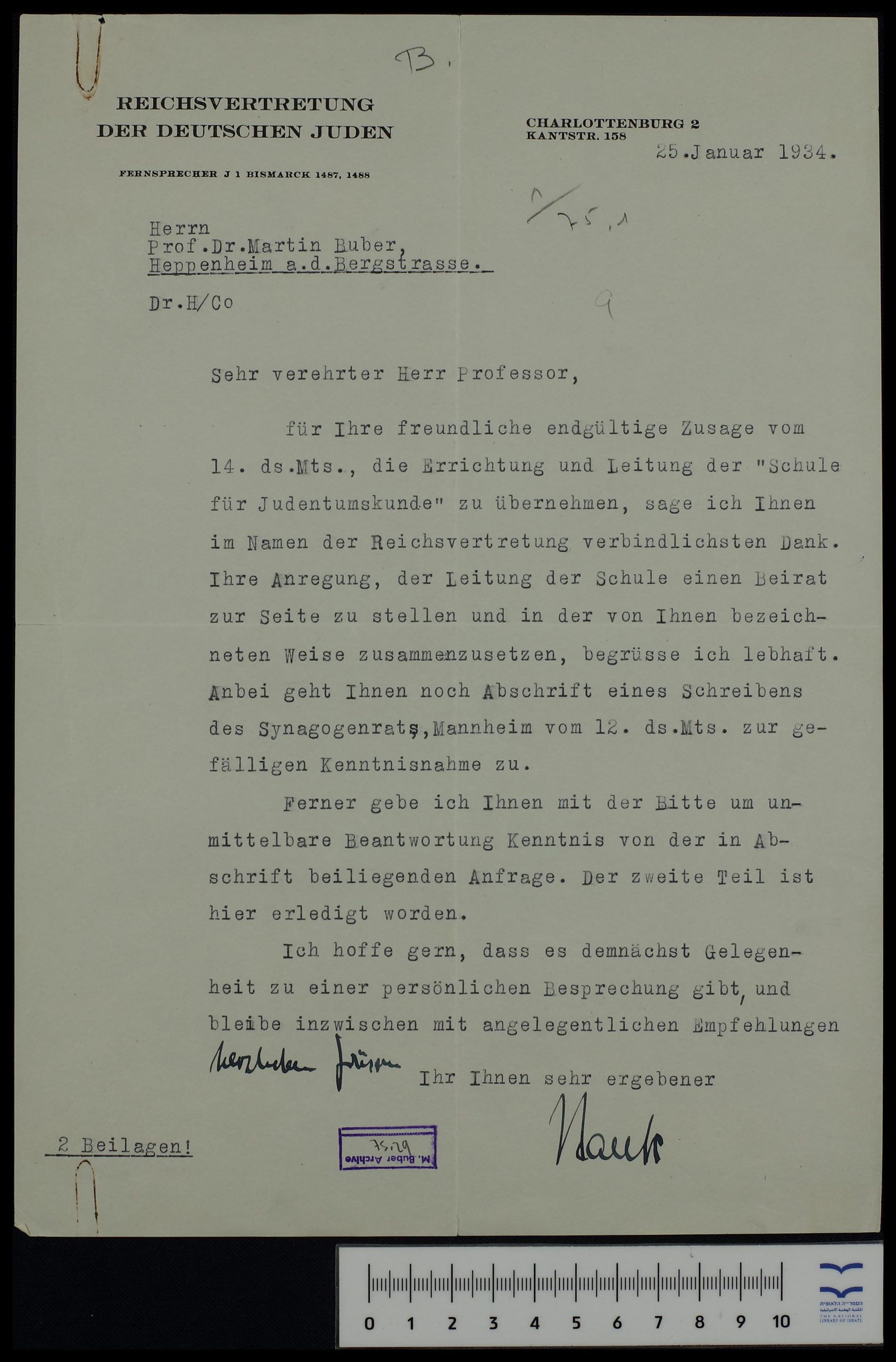
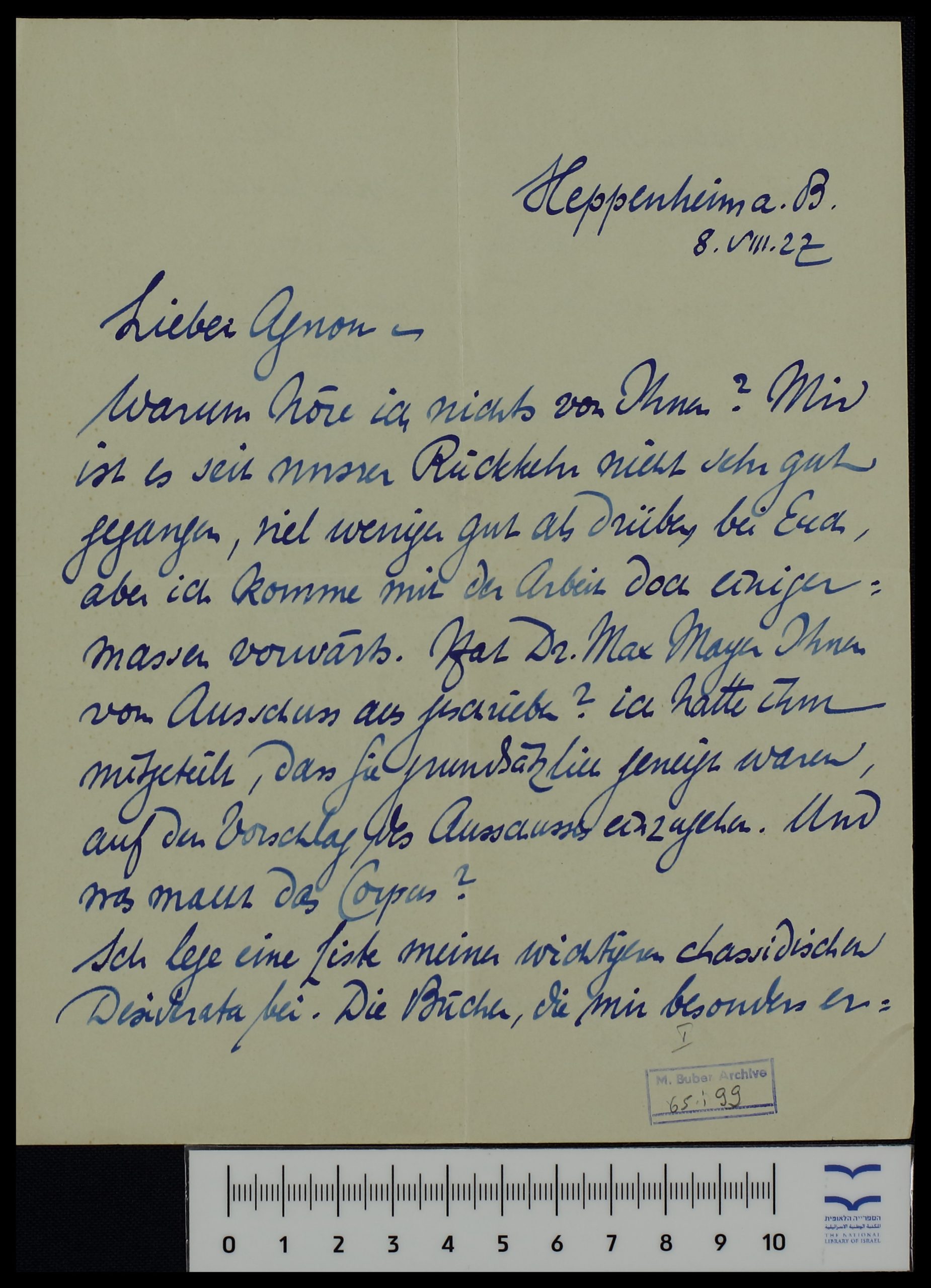
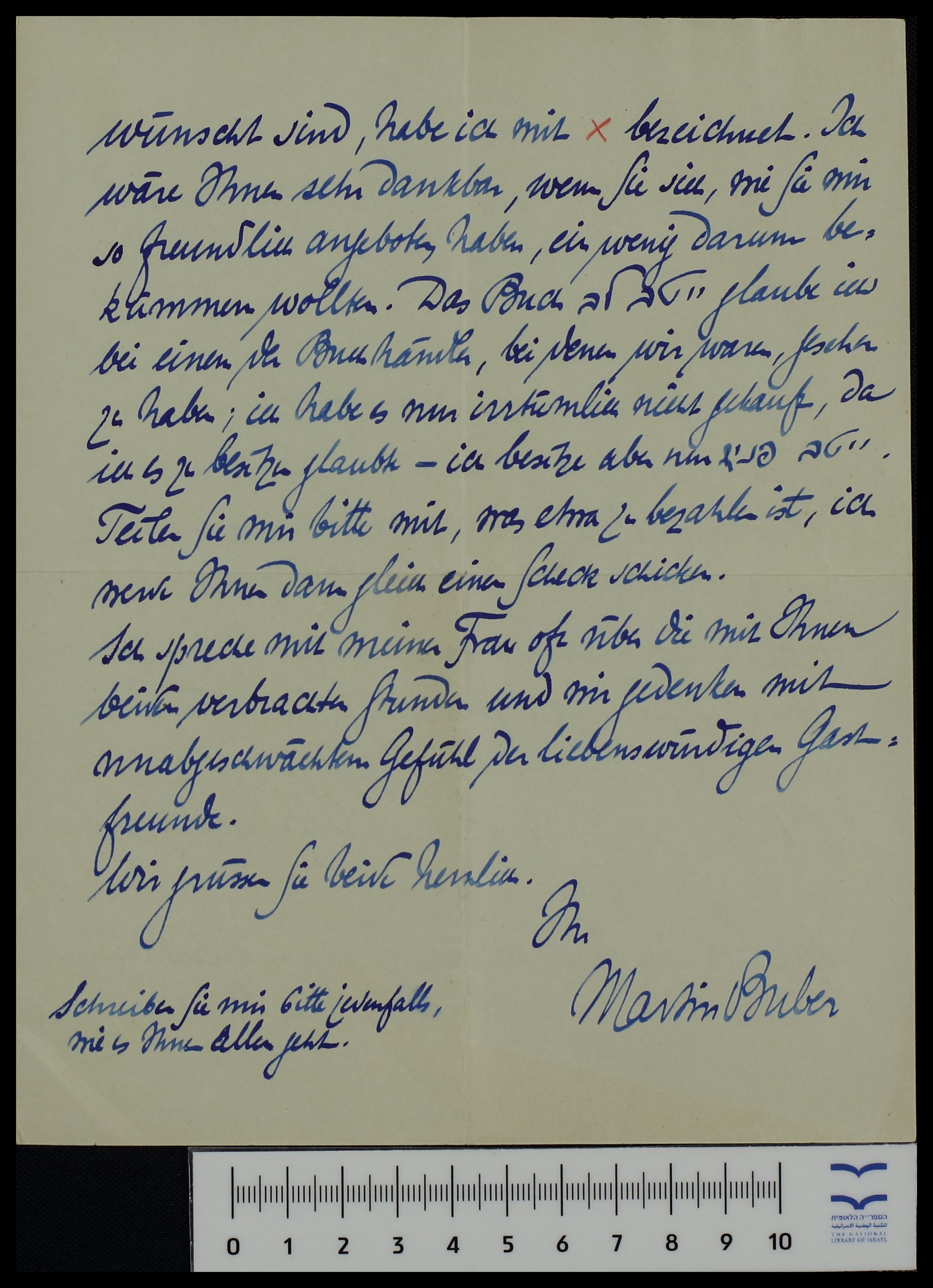
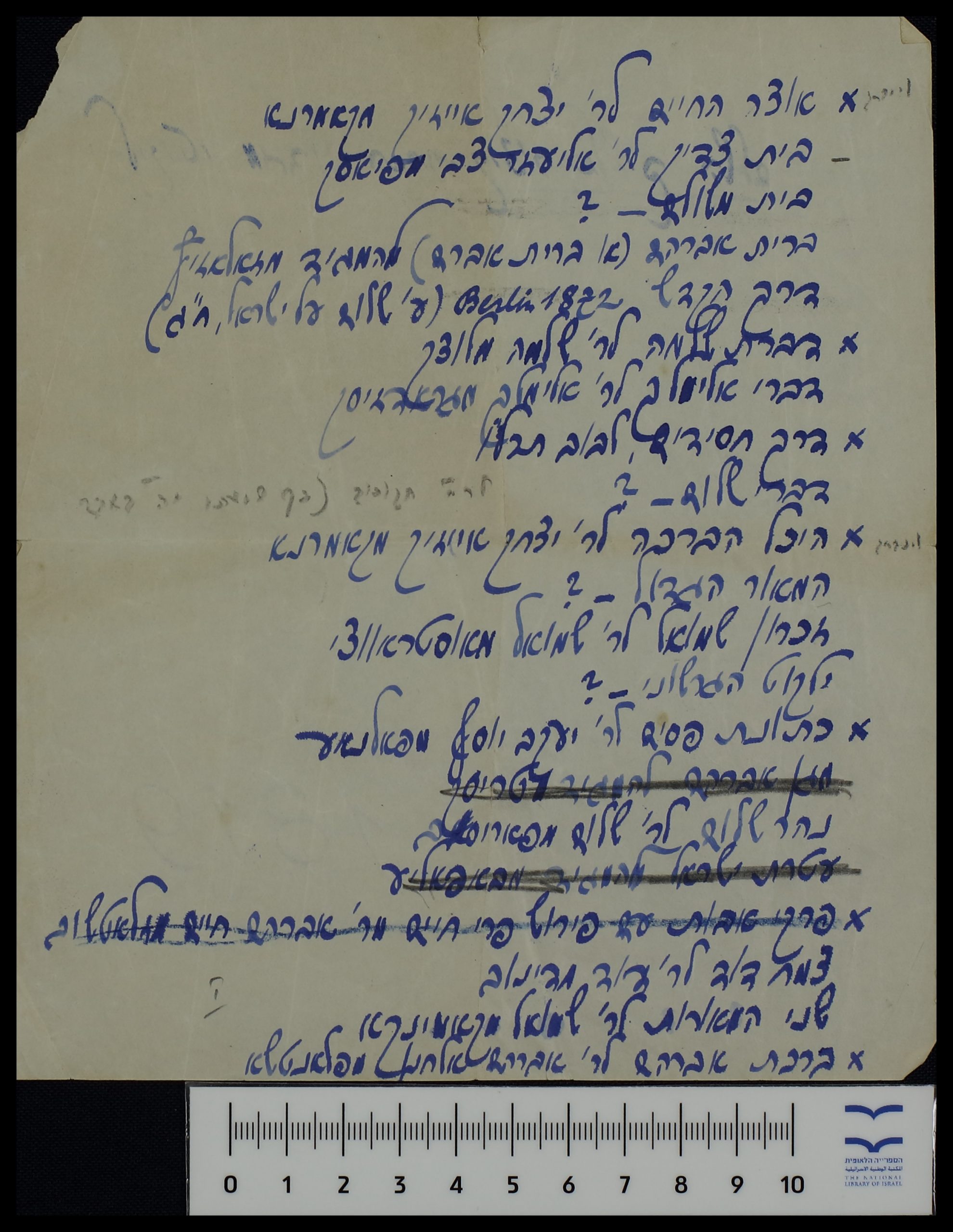
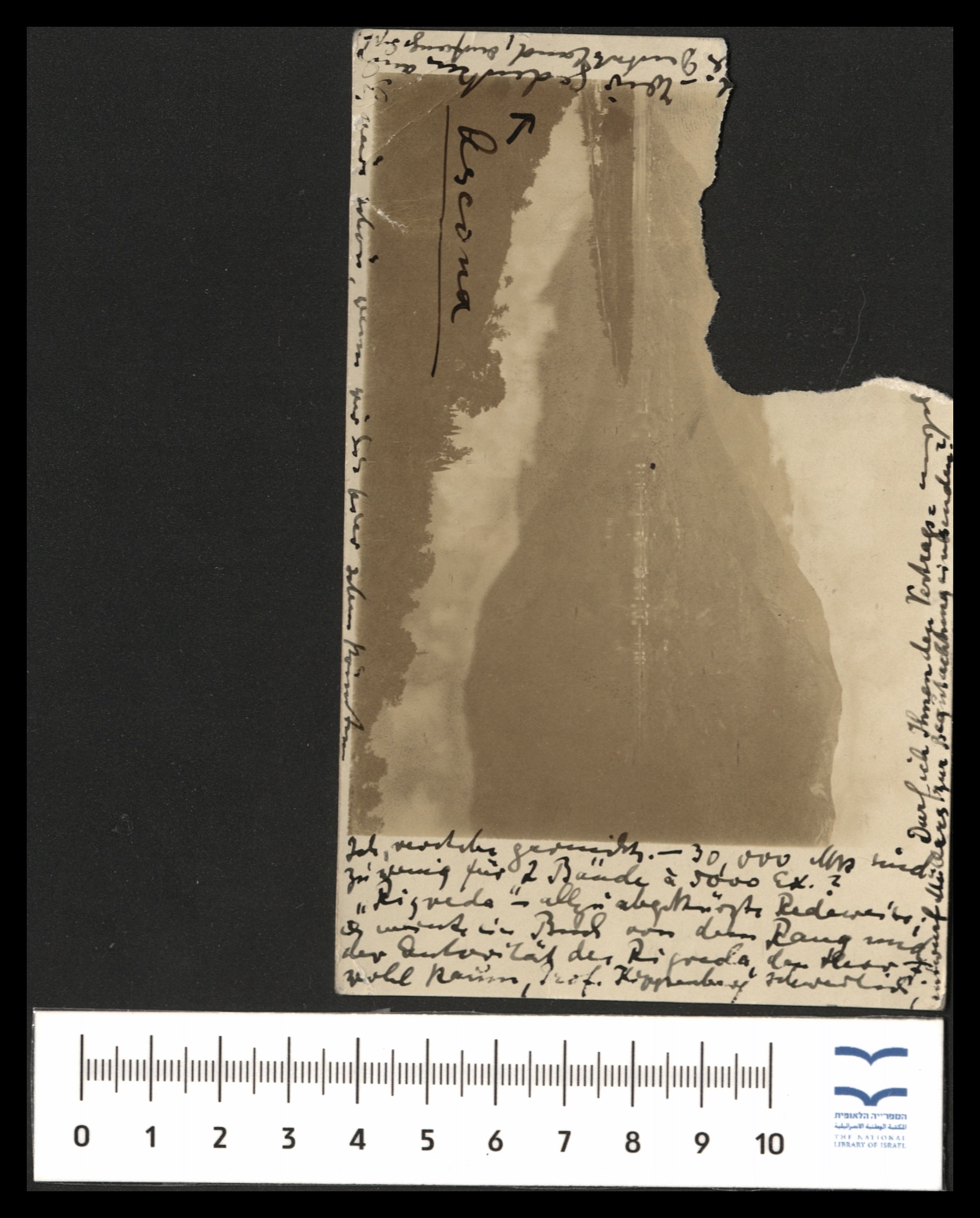
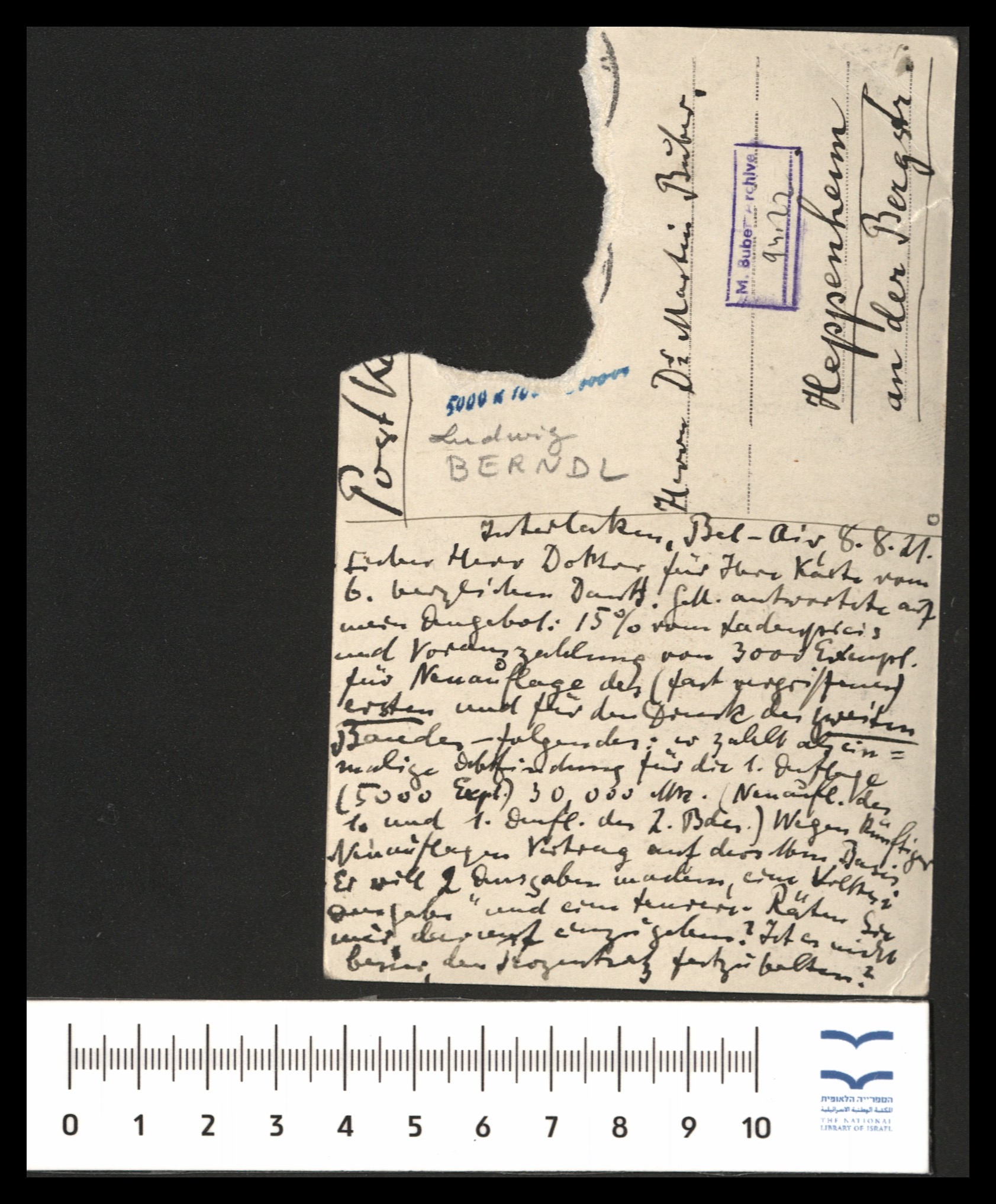
![Handwritten letter by Martin Buber on letterhead from the planned journal ›Der Jude‹ [1903], addressed to Marcus Ehrenpreis, 8 May 1903, p. 1](/wp-content/uploads/2026/01/BKD_Brief_MartinBuber_DerJude_MarcusEhrenpreis_1903_1_NLI_TamarGoldschmidt-scaled.jpg)
![Handwritten letter by Martin Buber on letterhead from the planned journal ›Der Jude‹ [1903], addressed to Marcus Ehrenpreis, 8 May 1903, p. 2](/wp-content/uploads/2026/01/BKD_Brief_MartinBuber_DerJude_MarcusEhrenpreis_1903_2_NLI_TamarGoldschmidt-scaled.jpg)
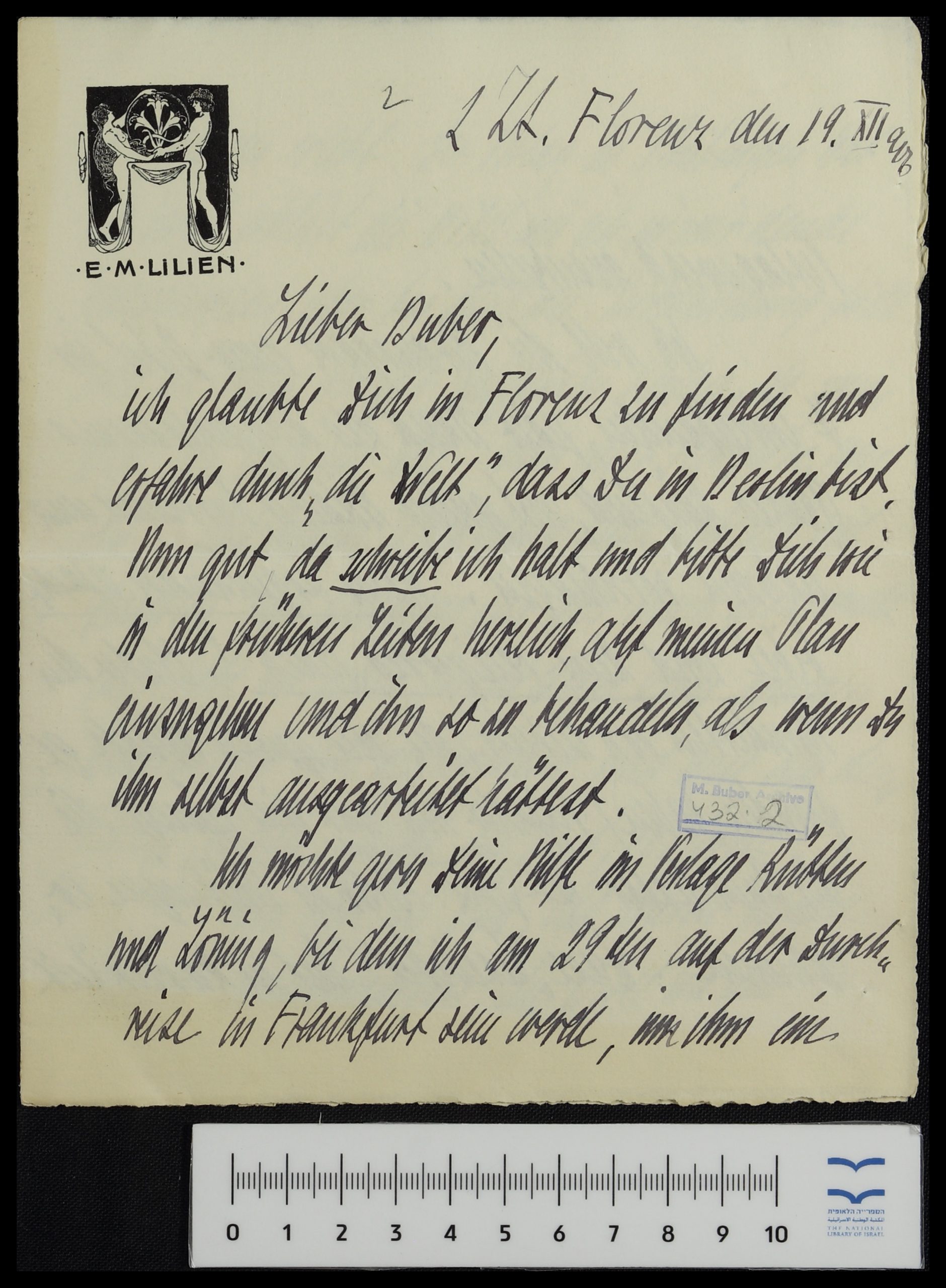
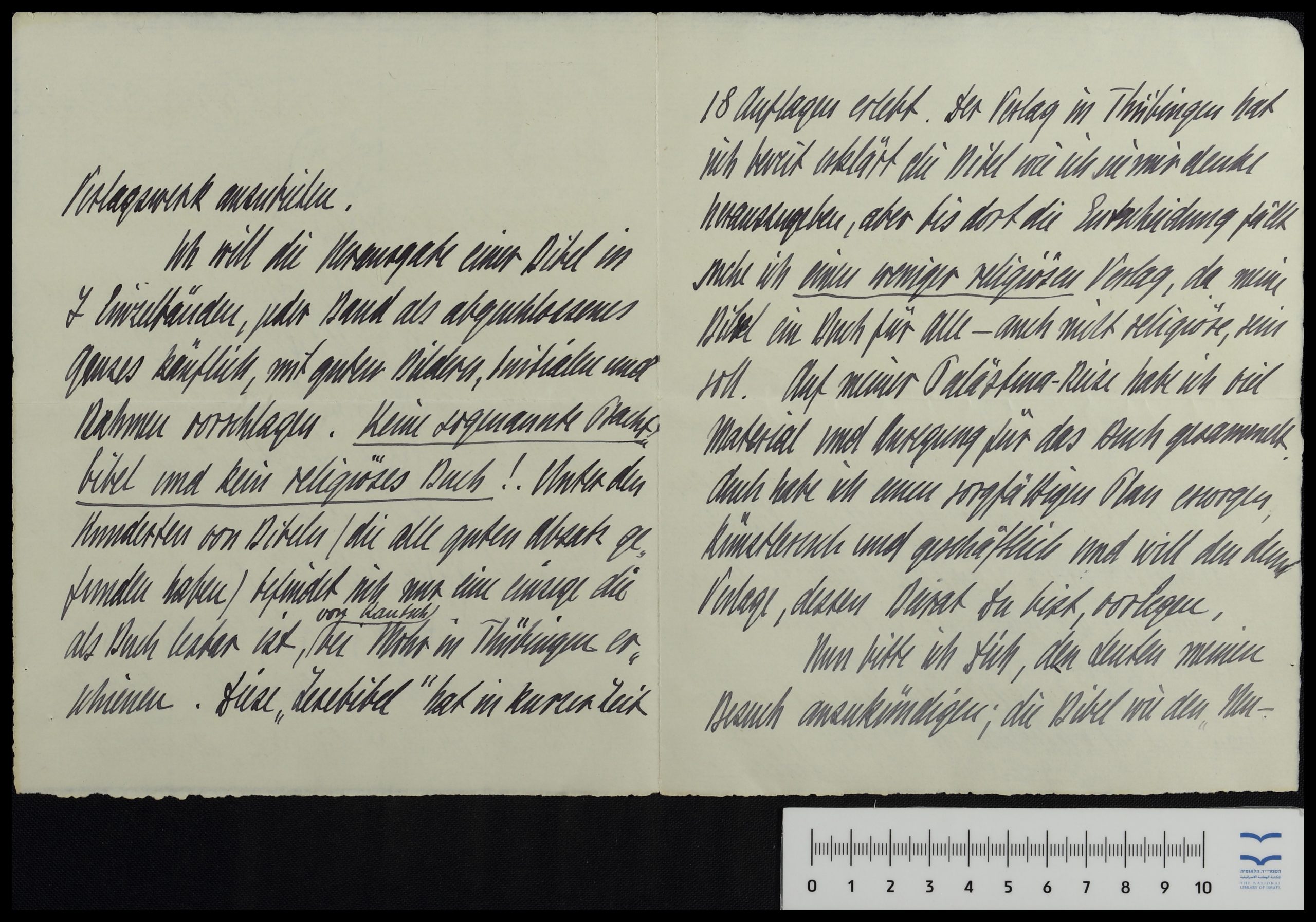
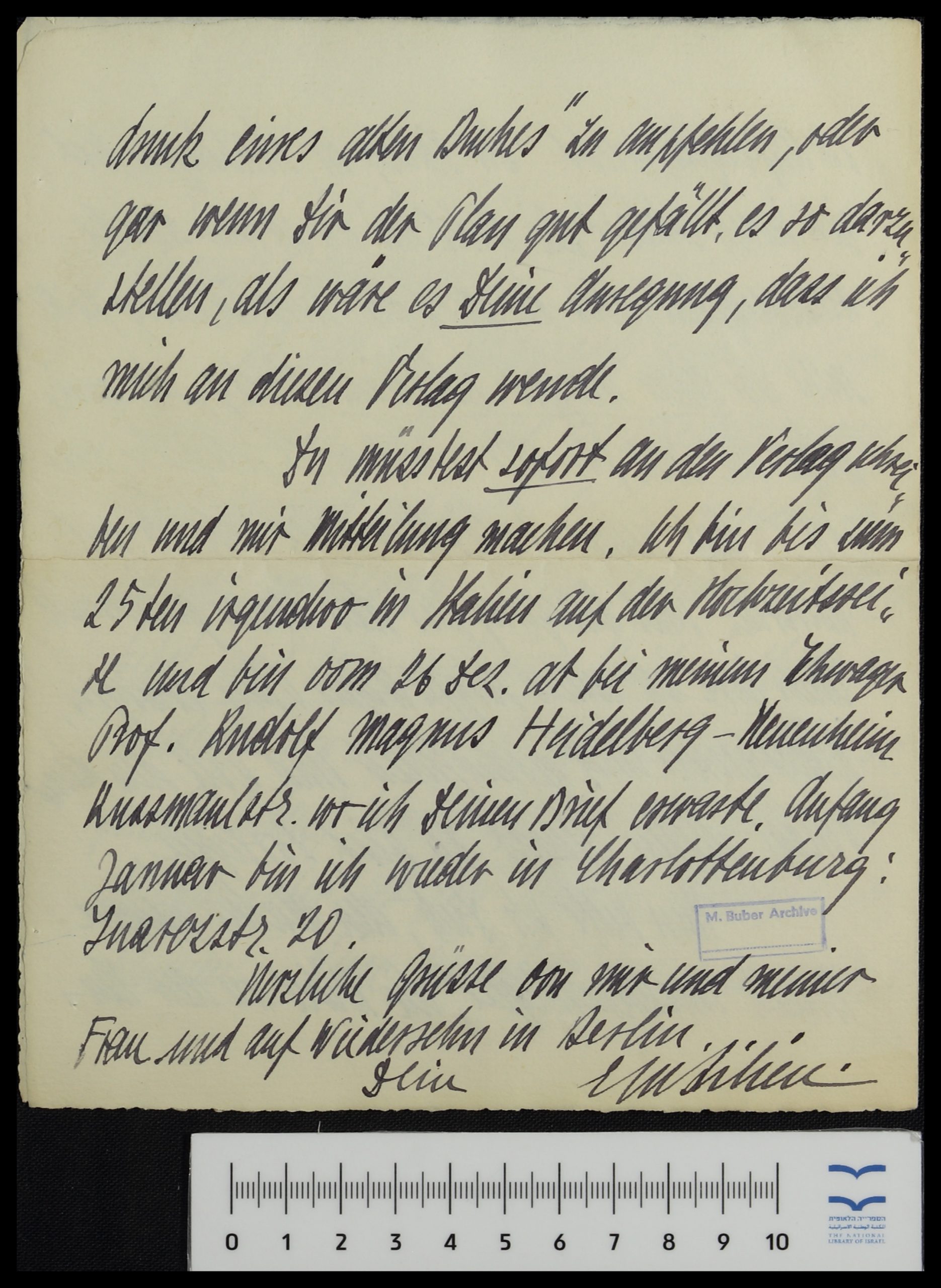
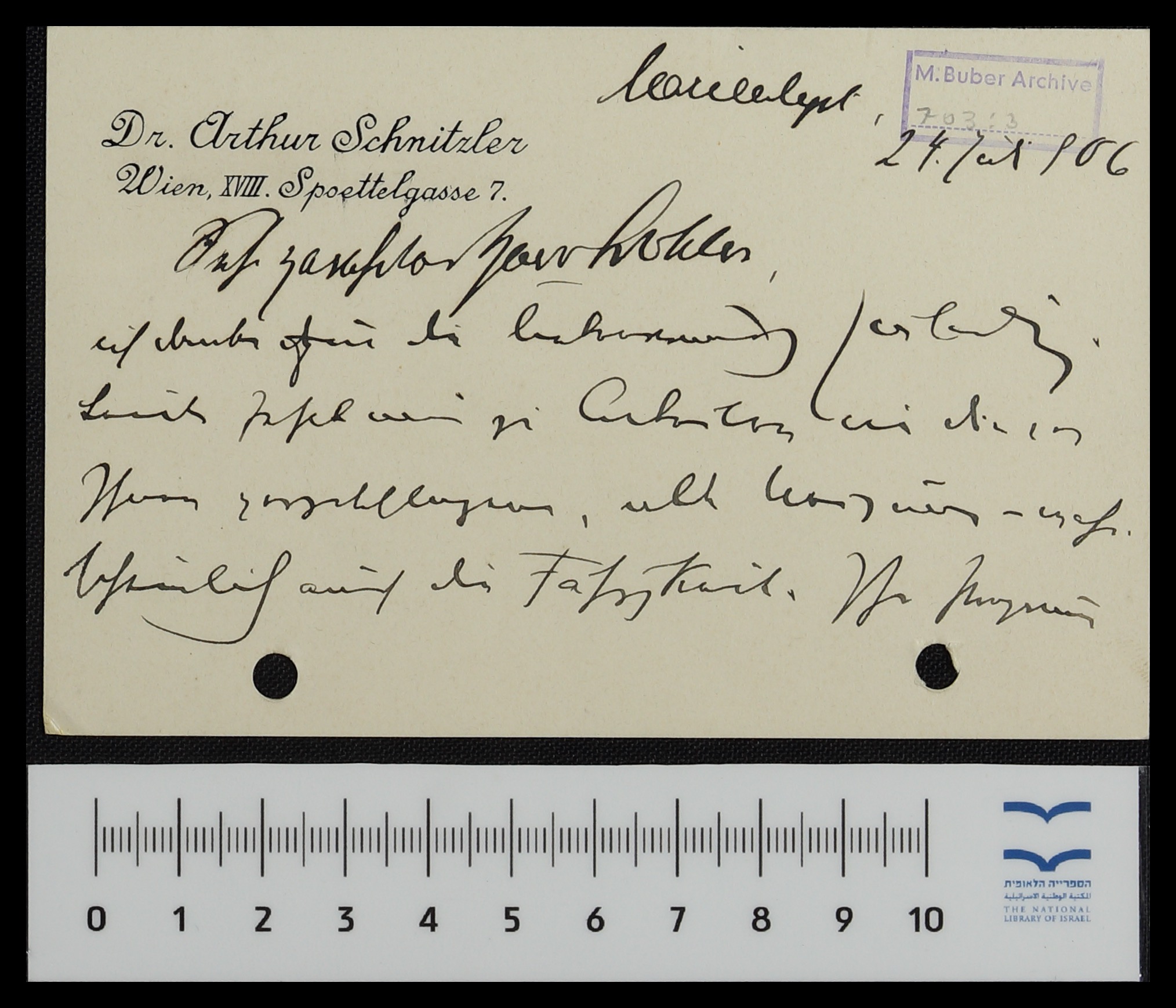
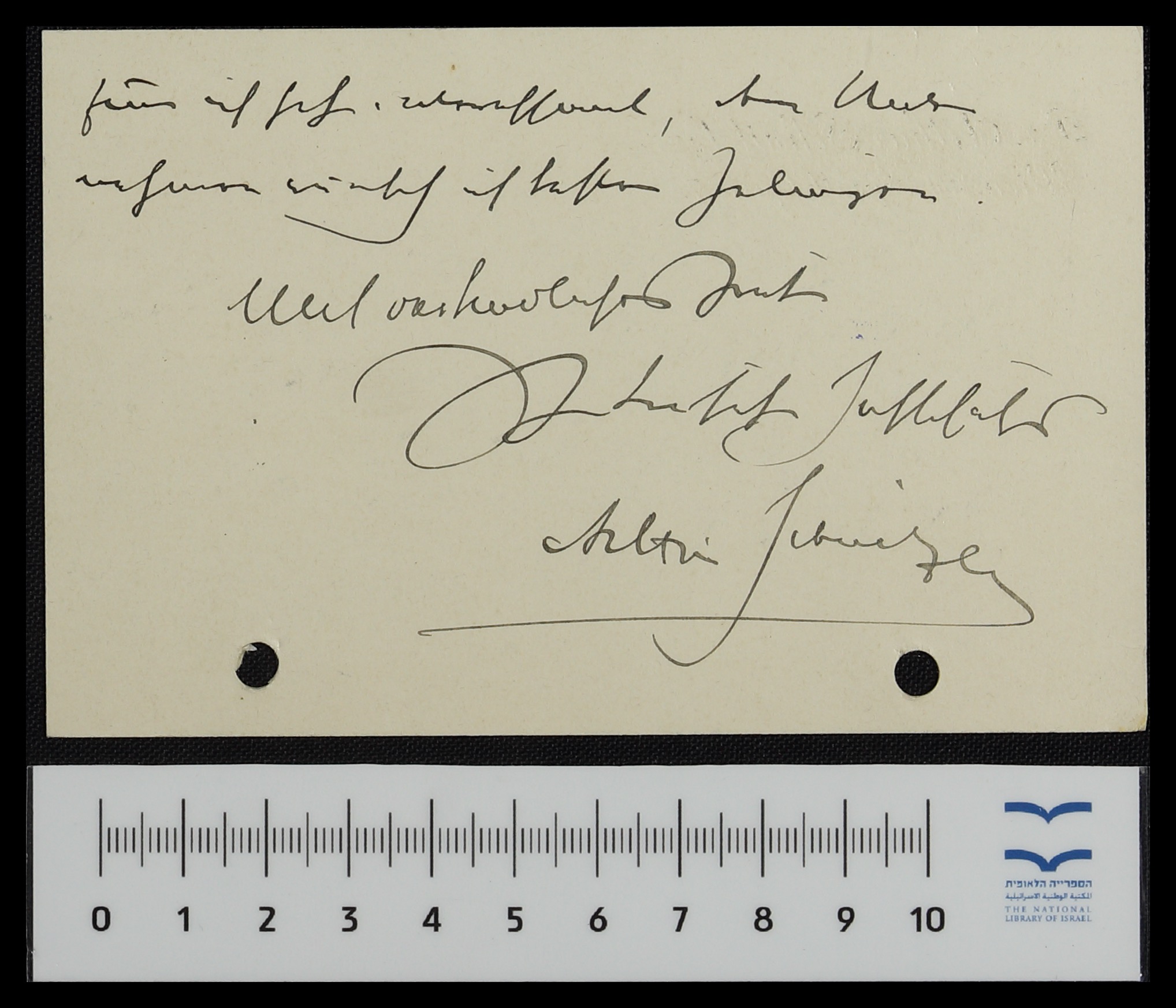
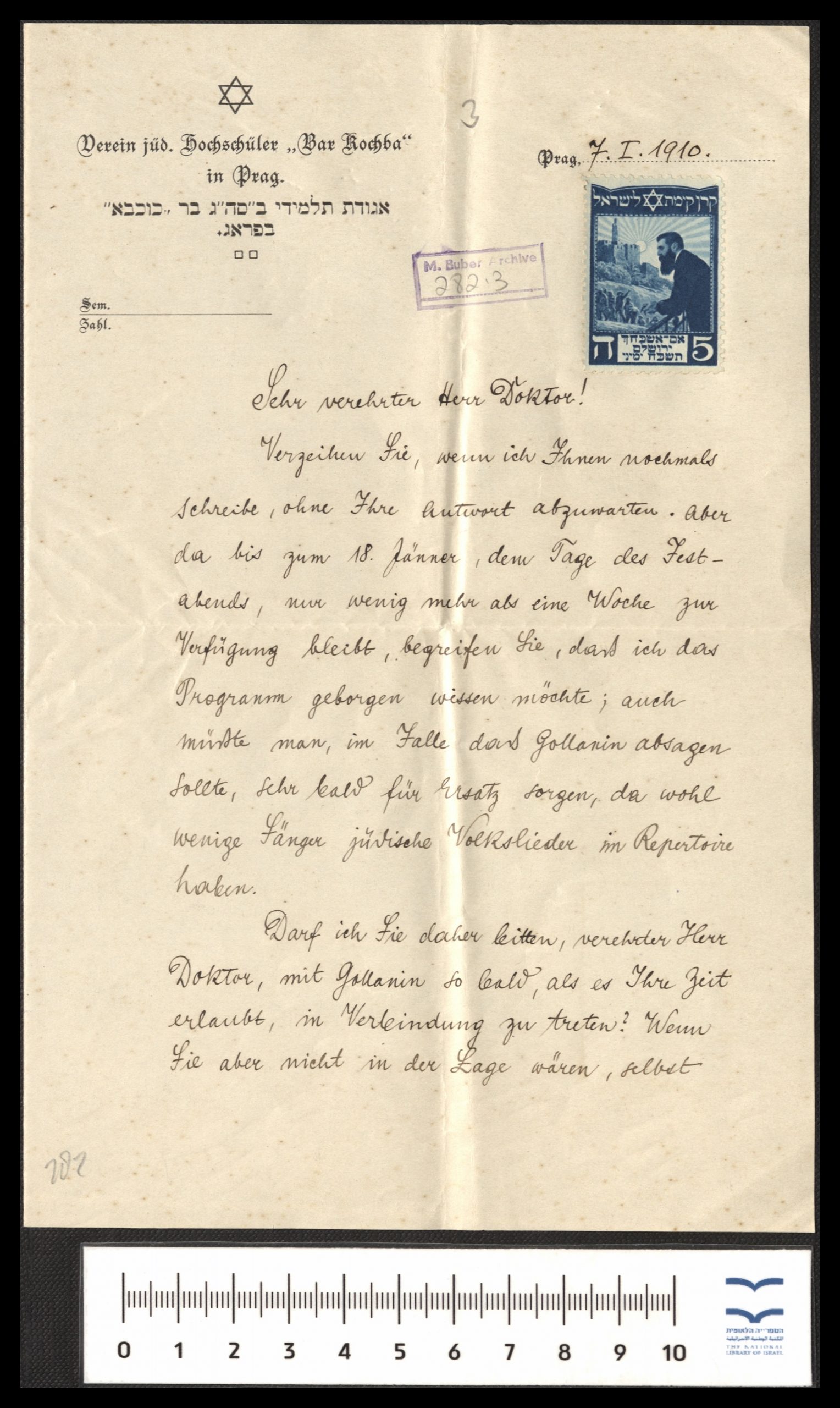
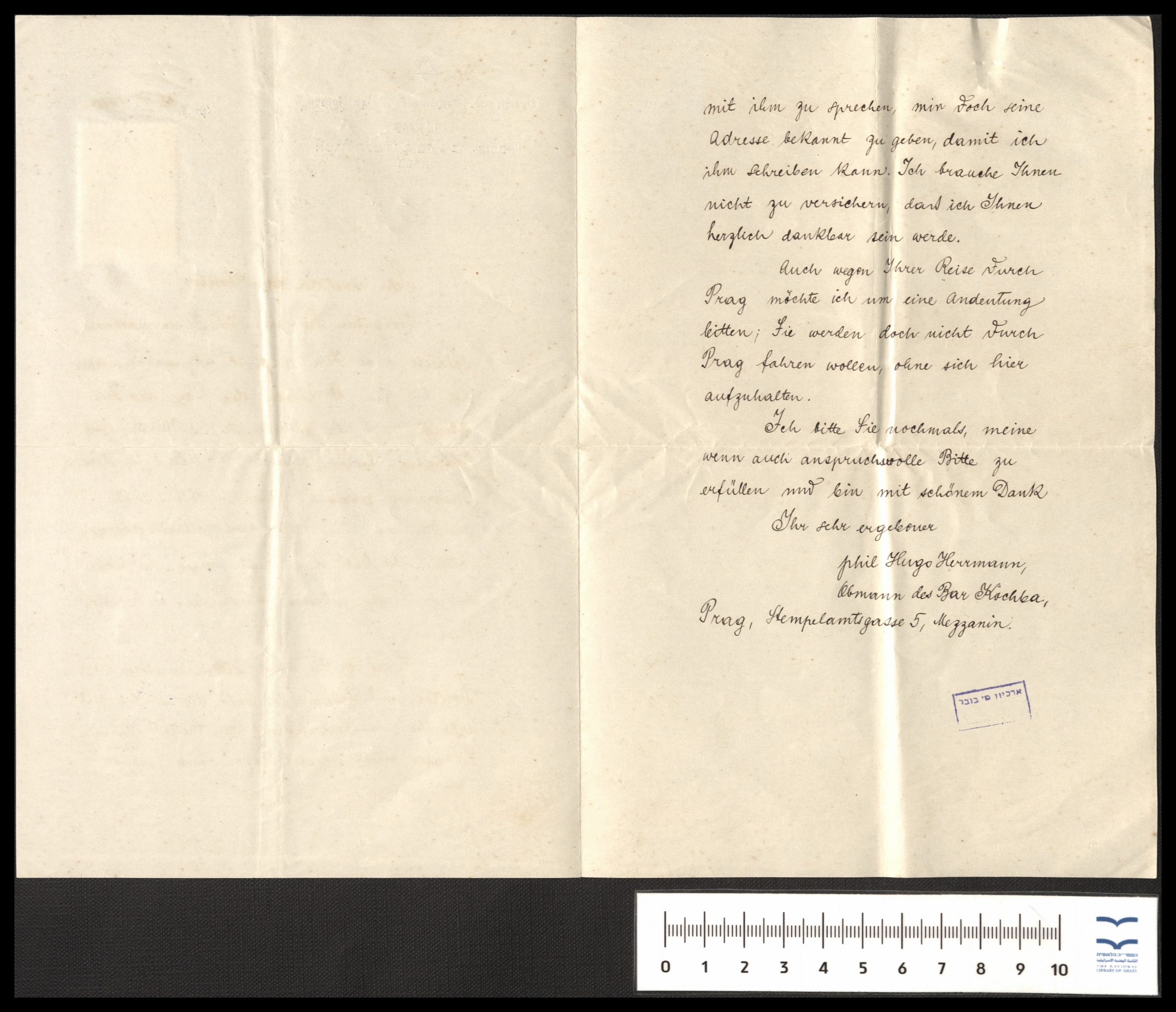
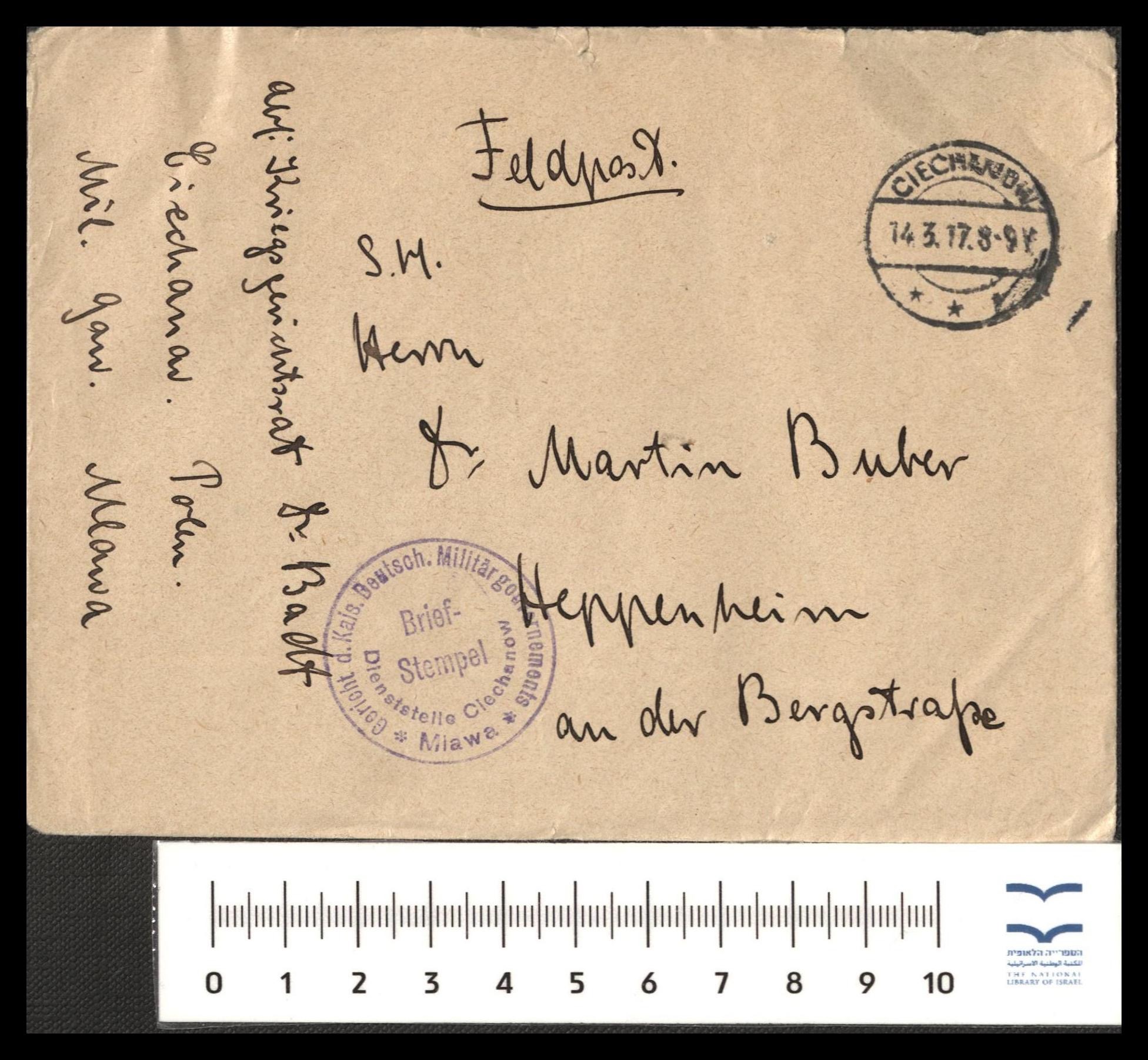
Ina Schimmer to Martin Buber, 25 March 1903
Brief –, Rohrpostkarte – Telegramm erhalten. Aber Martin wie wollen Sie auf einen Brief, den Sie am 23. Abends aufgeben, am 24. 1 Uhr Mittags schon Antwort haben! So weit sind wir mit der Postverbindung noch nicht. Sie haben wohl gestern einen nervösen Tag gehabt.
Editorial Concept
Editorial Modules
Martin Buber’s body of written work, spanning the diverse scholarly, cultural, political and social spheres in which he was active from the turn of the century until his death in 1965, can be situated within several broader contexts.
These contexts provide the basis for organizing the editorial project into eight thematic modules based on key research questions and for conducting a thematically focused analysis of the »epistolary discourses« of the period.
Modul 1: Jewish Renaissance – Cultural Zionism – Palestine / State of Israel
How did Jewish nationalism emerge, and how was it debated? Martin Buber’s letters trace the development of this idea from its beginnings through the establishment and early years of the State of Israel. His engagement with it spanned almost his entire life. The letters document the hopes, conflicts, and doubts expressed in his correspondence with leading intellectuals. How did Buber’s thought evolve over the decades? What ideas did he pursue for coexistence in Palestine?
The correspondence included in the first editorial module covers nearly the entirety of Buber’s intellectual and public career, from the turn of the twentieth century until his death in 1965. It enables an in-depth, contextualized analysis of the emergence and development of the idea of Jewish nationalism and the positions taken by Buber and other key figures. It also provides a deeper insight into the political and social debates in Palestine and, later, in the State of Israel. These debates initially took place within Jewish circles and subsequently also involved non-Jewish intellectuals. The module begins at the turn of the century with Buber’s early Zionist writings, which aimed to strengthen Jewish culture in the Diaspora and emerged within the context of the »Jewish Renaissance«, and with his engagement with Theodor Herzl’s political concepts. His speeches on Judaism, delivered to Prague’s Zionist circles centered around the »Bar Kochba« student association, shaped Buber’s work prior to World War I. In 1916, the founding of the journal Der Jude and his debate with Hermann Cohen on states, peoples, and Zion marked significant interventions in the public discourse on the role of Jewish nationalism within German Jewry. During World War I, Buber’s thought underwent a shift that would later make him a key figure in the contentious debates over Jewish-Arab coexistence in Palestine. He became a leading advocate of Brit Shalom’s proposals for a binational community. Although Buber defended the right of Jews from Europe to settle in Palestine, by the time he himself emigrated there in 1938, he had become an outspoken critic of nationalist tendencies within the Zionist movement and a strong advocate for the rights and equal treatment of the Arab population.
Key correspondents featured in this module include Achad Ha’am, Chaim Arlosoroff, David Ben-Gurion, Shmuel H. Bergman, Nathan Birnbaum, Zevi Diesendruck, Albert Einstein, Nahum Goldmann, Leo Herrmann, Theodor Herzl, Hans Kohn, Jehuda L. Magnes, Salman Schocken, Chaim Weizmann and Robert Weltsch.
Modul 2: Religion(s) and Religious Studies
What were Martin Buber’s views on religion, mysticism, and the meaning of human existence? His letters offer insight into his engagement with Jewish and non-Jewish religious and philosophical traditions, ranging from Hasidism to Chinese philosophy. They reveal how his own thought evolved over time. How did Buber connect mysticism with the modern search for meaning? And what did dialogue, redemption, and faith mean to him in this context?
Philosophical interpretations of religion and religiosity, as well as the scholarly study of religious phenomena and traditions, are central to Buber’s work. This focus is also reflected in his correspondence. The module begins with correspondence concerning ideas explored in Buber’s early writings on religion prior to World War I. These include the role of myth in religion and, above all, the renewed emphasis he placed on mysticism within Judaism through his early engagement with Hasidism. The module also includes correspondence relating to his studies and collections concerning non-Jewish mystical traditions. Central to the module is Ecstatic Confessions (1909), a work that emerged within the context of a search for meaning shaped by Neo-Romanticism and the German philosophy of life in response to the crises of modernity. It brought together mystical texts from different periods, religions, and cultural spheres. The correspondence in this module also addresses Buber’s later theoretical writings on Hasidism. In the 1920s, he interpreted it through the lens of his philosophy of dialogue, and later, in the 1940s and 1950s, he revisited it in the context of his philosophical anthropology. The correspondence also addresses his Hasidic novel Gog and Magog (1943), whose plot is shaped by differing conceptions of redemption and messianism. The module further includes letters concerning Buber’s interpretation of the »Oriental spirit« and his role as a translator and interpreter of Chinese literature and philosophy, particularly Taoist philosophy.
The module focuses, among others, on Buber’s correspondence with Alexander Altmann, Leo Baeck, Fritz J. Baer, Salo W. Baron, Schalom Ben-Chorin, Micha Josef Berdyczewsky, Eugen Diederichs, Ahron Eliasberg, Louis Finkelstein, Erich Gutkind, Stephen Hay, Isaak Heinemann, Samuel A. Horodetzky, Karl Kerényi, Joseph Klausner, Baruch Kurzweil, Alfred Mombert, Georg Müller, Rudolf Otto, Ernst Elijahu Rappeport, Gershom Scholem, Avraham Shapira, Moritz Spitzer, Jakob Taubes, and Kurt Wolff.
Modul 3: Dialogical Thought – Philosophy of Religion
What does it mean to truly encounter another person? Martin Buber’s philosophy of dialogue shaped 20th-century thought far beyond Jewish debates. His letters reveal how the ideas expressed in »I and Thou« evolved into a comprehensive philosophical worldview and how Buber used it to respond to war, violence, and moral crises. How does dialogue transform our view of what it means to be human? And what can philosophy of religion offer in times of catastrophe?
Buber’s influence and prominence, both in Jewish cultural life during the Weimar Republic and in German intellectual life more broadly, were closely linked to his role as one of the founders of the philosophy of dialogue. This philosophy provided significant impetus for a wide range of debates in theology, pedagogy, psychotherapy, social ethics, and politics. The module first focuses on Buber’s philosophical thought after he turned away from the mysticism and Neo-Romanticism that shaped his earlier work. Numerous correspondences concern the publication of his major work I and Thou (1923) and his further elaboration of the implications of dialogical thought for hermeneutics, aesthetics, ethics, and pedagogy in writings from the 1930s. The relevant correspondence extends from the 1920s through the postwar reception of his work. The second focus is on correspondence concerning Buber’s later engagement with philosophy of religion. Building on his philosophy of dialogue, he engaged with the consequences of the crises and catastrophes of the 20th century. Buber addressed these issues in works such as Images of Good and Evil (1952) and Eclipse of God (1953).
Among the key exchanges in this module are those with Jochanan Bloch, Seymour Cain, Emil L. Fackenheim, Maurice Friedman, Hermann Levin Goldschmidt, Will Herberg, Walter A. Kaufmann, David Koigen, Eugen Rosenstock-Huessy, Franz Rosenzweig, Nathan Rotenstreich, Leo Shestov, and Ewald Wasmuth.
Modul 4: Philosophy of Language – Translation – Biblical Commentary
How do language and translation shape our understanding of the world and of faith? Martin Buber saw language as more than just a tool. For him, it was a space of encounter. His letters reveal his reflections on Bible translation, multilingualism, and biblical commentary. How can translation preserve meaning? And how can interpreting Scripture open paths to faith and mutual understanding?
Questions of language, multilingualism, translation, and commentary play a central role in Buber’s work from the very beginning and across the many contexts in which he was active. This module begins with Buber’s early reflections on the philosophy of language, which he developed in dialogue with figures such as Fritz Mauthner and Hugo von Hofmannsthal and, during the 1920s, with the Patmos Circle. The focus then shifts to the correspondences relating to the »German rendering« of Scripture, a project that Buber and Rosenzweig initiated in 1925 and that Buber continued alone after Rosenzweig’s death in 1929. The module also considers correspondence concerning Buber’s work as an interpreter of the Hebrew Bible, particularly as the author of the biblical commentaries Kingship of God (1932), Moses (1948), and The Prophetic Faith (1950). These works implicitly engage with the challenges facing Europe and Palestine at the time. Buber’s philosophical reflections on the restoration of language in response to the linguistic crisis of modernity, as set out in his writings of the 1950s and 1960s, also play a significant role in the letters.
Among the key correspondences in this module are those with Rudolf Borchardt, Umberto Cassuto, Hans Ehrenberg, Rudolf Ehrenberg, Nahum N. Glatzer, Abraham J. Heschel, Hugo von Hofmannsthal, Benno Jacob, Fritz Mauthner, Felix Perles, Gerhard von Rad, Eugen Rosenstock-Huessy, Franz Rosenzweig, Eduard Strauss, and Ludwig Strauß.
Modul 5: Challenges to Christianity and Critical Dialogue with Christian Theology
What makes genuine dialogue between Judaism and Christianity possible? Martin Buber sought dialogue with leading Christian theologians of his time about the Bible, faith, and their shared responsibility for the world. His letters reveal affinities, disagreements, and a sustained effort to achieve mutual understanding. What separates these two religions, and what unites them? And what role does dialogue play after the Shoah?
Few Jewish scholars of the early 20th century developed their interpretation of Judaism and their philosophical thought through such sustained critical engagement with Christianity as Buber did. His work challenged Christian theology’s understanding of the biblical foundations of Christianity in both the Hebrew Bible and the New Testament. At the same time, he engaged in an intensive dialogue with numerous Protestant and Catholic theologians onJewish-Christian relations, the conditions necessary for meaningful interreligious dialogue, and the shared responsibility of Jews and Christians in politics and society. These conversations are reflected in a substantial body of correspondence. The module begins with Buber’s early contacts with Christian theologians in circles engaged in cultural criticism before and during World War I. It then places strong emphasis on Buber’s interreligious relationships during the Weimar period, his dialogue with representatives of religious socialism, and his reflections on interreligious dialogue in the context of the publication of the journal Die Kreatur (1926–1930). The focus is also on Jewish-Christian dialogues and confrontations around 1933, as well as on Buber’s interpretation of Christianity in his 1934 lectures on Judaism and Christianity at Frankfurt’s Freies Jüdisches Lehrhaus. These lectures formed the basis of his widely discussed book Two Types of Faith (1950). After 1945, Jewish-Christian dialogues conducted through correspondence also offer insight into Buber’s complex relationship with Germany in the wake of the Shoah.
Among the key correspondences in this module are those with Hans Urs von Balthasar, Karl Barth, Arthur Bonus, Emil Brunner, Rudolf Bultmann, Friedrich Gogarten, Romano Guardini, Alfred Jeremias, Hans Kosmala, Otto Michel, Alfons Paquet, Leonhard Ragaz, Florens Christian Rang, Karl-Heinrich Rengstorf, Karl-Ludwig Schmidt, Karl Thieme, Paul Tillich, Viktor von Weizsäcker, Joseph Wittig, and Carly Witton Davies.
Modul 6: Literature – Art – Theater
What did literature and art mean to Martin Buber? His letters reveal his place within an extensive network of writers, artists, and intellectuals in Europe, Mandatory Palestine, and Israel. From Franz Kafka to Else Lasker-Schüler, this correspondence reflects intellectual exchange, mutual inspiration, and disagreement. How did these encounters shape Buber’s thought? And how did he, in turn, influence writers and artists?
The correspondence included in this module clearly shows that Buber engaged in literary work and explored questions of artistic production throughout his life, particularly in his younger years. His acquaintances and friends included many of the leading intellectuals of his time, and writers from diverse cultural and political backgrounds were strongly drawn to him. The module reconstructs Buber’s extensive network of contacts with Jewish and non-Jewish artists and cultural figures and analyzes it from a cultural-historical perspective. It traces his network from his encounters before World War I with Viennese literary circles engaged in cultural criticism, writers associated with the Prague Circle and intellectuals of the Forte Circle, through his relationships with Jewish artists and writers in the context of Zionism and the »Jewish Renaissance«, to his correspondence with numerous European writers, actors, theater directors, and painters during the interwar period and after World War II.
Among the many significant correspondences that also concern Hebrew literature in pre-state Palestine and Israel, the most important are those with Joseph S. Agnon, Johannes Baader, Julius Bab, Hermann Bahr, Richard Beer-Hofmann, Walter Benjamin, Max Brod, Hans Carossa, Theodor Däubler, Richard Dehmel, Alfred Döblin, Louise Dumont, Berthold Feiwel, Yaakov Fichmann, Albrecht Goes, Hermann Hesse, Hugo von Hofmannsthal, Franz Kafka, Jakob Klatzkin, Werner Kraft, Else Lasker-Schüler, Oskar Loerke, Thomas Mann, Arno Nadel, David Pinski, Romain Rolland, Hermann Struck, Margarete Susman, Jakob Wassermann, Franz Werfel, Karl Wolfskehl, Arnold Zweig, and Stefan Zweig.
Modul 7: Political Philosophy – Social Philosophy
How did Martin Buber connect politics, ethics, and responsibility? His letters reveal his exchanges with socialists, pacifists, conservatives, and thinkers from around the world. They reflect his struggle for justice, community, and peace in a divided world. What role should religion play in politics? And how can we conceive of human responsibility?
Throughout his life, Buber engaged with questions of politics and social-philosophy beyond his Zionist activism and maintained wide-ranging contacts with intellectuals from across the political spectrum. The module examines the diverse roots of Buber’s political thought, in the youth movement, Neo-Romantic ideas, and in the communal socialist ideas associated with the »Neue Gemeinschaft« during the first decade of the 20th century. It also considers his critical friendship with Gustav Landauer and his changing political stance during World War I. Its principal focus, however, is on the themes that shaped his thinking after 1918: the emphasis on social responsibility associated with his philosophy of dialogue and debates over the relationship between religion and politics. These concerns found expression in numerous essays on the universal significance of biblical prophecy (e.g., The Holy Way, 1919), as well as in his exchanges with religious socialists, many representatives of the Jewish women’s movement, and conservative and right-wing political opponents, including supporters of National Socialism. The correspondence also addresses Buber’s sociopolitical writings from 1938 to 1965, in particular Paths in Utopia (1950), his major work on the history of socialist ideas and communitarian practice. It also covers his views on the Cold War, international understanding, and the death penalty, including in the context of the Eichmann trial.
Among the key correspondences in this module are those with Eduard Bernstein, Nathan Chofshi, Dora Edinger, Shmuel N. Eisenstadt, Mahatma Gandhi, Victor Gollancz, Dag Hammarskjöld, Erich Kahler, Hanna Karminski, Gustav Landauer, Bertha Pappenheim, E. Pinchas Rosenblüth, Bertrand Russell, Albert Schweitzer, Georg Simmel, and Ferdinand Tönnies.
Modul 8: Philosophical Anthropology – Education – Psychology / Psychotherapy
What role do relationships and encounters play in educational processes? Buber’s letters reveal his commitment to education, pedagogy, and human psychology. They reflect his ideas about dialogue, healing, and human development in schools, teaching institutions, and academic settings. What questions at the intersection of pedagogy and philosophical anthropology emerge from Buber’s correspondence? And how can pedagogy shape society?
A final set of topics central to Buber’s intellectual network concerns questions of education and pedagogy, as well as anthropology and psychology. This module focuses on contemporary debates on educational theory and progressive education. From World War I through the 1950s, he contributed to these discourses through writings on youth, education, and educational practice. Particular attention is given to the educational work of Frankfurt’s Freies Jüdisches Lehrhaus from 1921 to 1938, to adult education in the State of Israel, as well as to Buber's academic work in Frankfurt and Jerusalem. Furthermore, the module highlights the extent to which Buber’s writings on philosophical anthropology, psychology, and psychotherapy resonated with his contemporaries, as reflected in their letters. This resonance is already evident in Buber's work as editor of the social-psychological series Die Gesellschaft (1906–1912), which is regarded as foundational to German sociology. Particularly important in this regard are later works such as Die Frage an den Einzelnen (1936) or Das Problem des Menschen (1948), which, in their engagement with psychoanalysis, emphasized the healing potential of dialogical relationships. The module also gives particular attention to Buber’s engagement with the thought of Sigmund Freud and C.G. Jung.
Key correspondence in this field of discourse includes exchanges with Lou Andreas-Salomé, Ludwig Binswanger, Wolf Dohrn, Leslie H. Farber, Abraham Halevy Fraenkel, Viktor E. Frankl, Sigmund Freud, Paul Geheeb, Hermann M. Gerson, Otto Hirsch, Ernst Joel, Ellen Key, Siegfried Lehmann, Rudolf Pannwitz, Carl Rogers, Elisabeth Rotten, Ernst Simon, Kurt Singer, Ronald Gregor Smith, and Hans Trüb.
Modul 0: Institutional Networks / Miscellanea
Some items of correspondence cannot be clearly assigned to any of the eight thematic modules. These include, for example, purely congratulatory letters or letters dealing l exclusively with private or family matters.
A large portion of the »General Correspondence« (including ›fan mail‹) and the »Correspondence with Publishers« also remains unassigned to any module. The latter encompasses exchanges not only with major publishers such as Lambert Schneider, Hegner, and Schocken Verlag, but also with numerous smaller publishers in Europe, Israel, and the United States. These exchanges concerned matters such as translations of Buber’s works, reprints and new editions.
Buber Correspondence Digital Edition
Methodological Approach
Find out here how the project handles the vast amount of material and how editorial and digital concepts interplay: