METHODOLOGY
Buber Correspondence Digital Edition
The Dialogical Principle in Martin Buber’s Scholary and
Intellectual Networks in the 20th Century
READ ENCODE EXPLORE
The Digital Editorial Approach
The Martin Buber Archive at the National Library of Israel (NLI) and other archives hold approximately 41,000 letters to and from the religious philosopher Martin Buber. Written in at least 16 languages, these letters were exchanged between Buber and more than 7000 correspondents over a period of more than 70 years. This unique corpus documents twentieth-century German-Jewish, German-Israeli, and Christian-Jewish discourses as few other collections do. Enabling researchers to explore it requires more than simply providing access to the approximately 110,000 digitized images of letters.
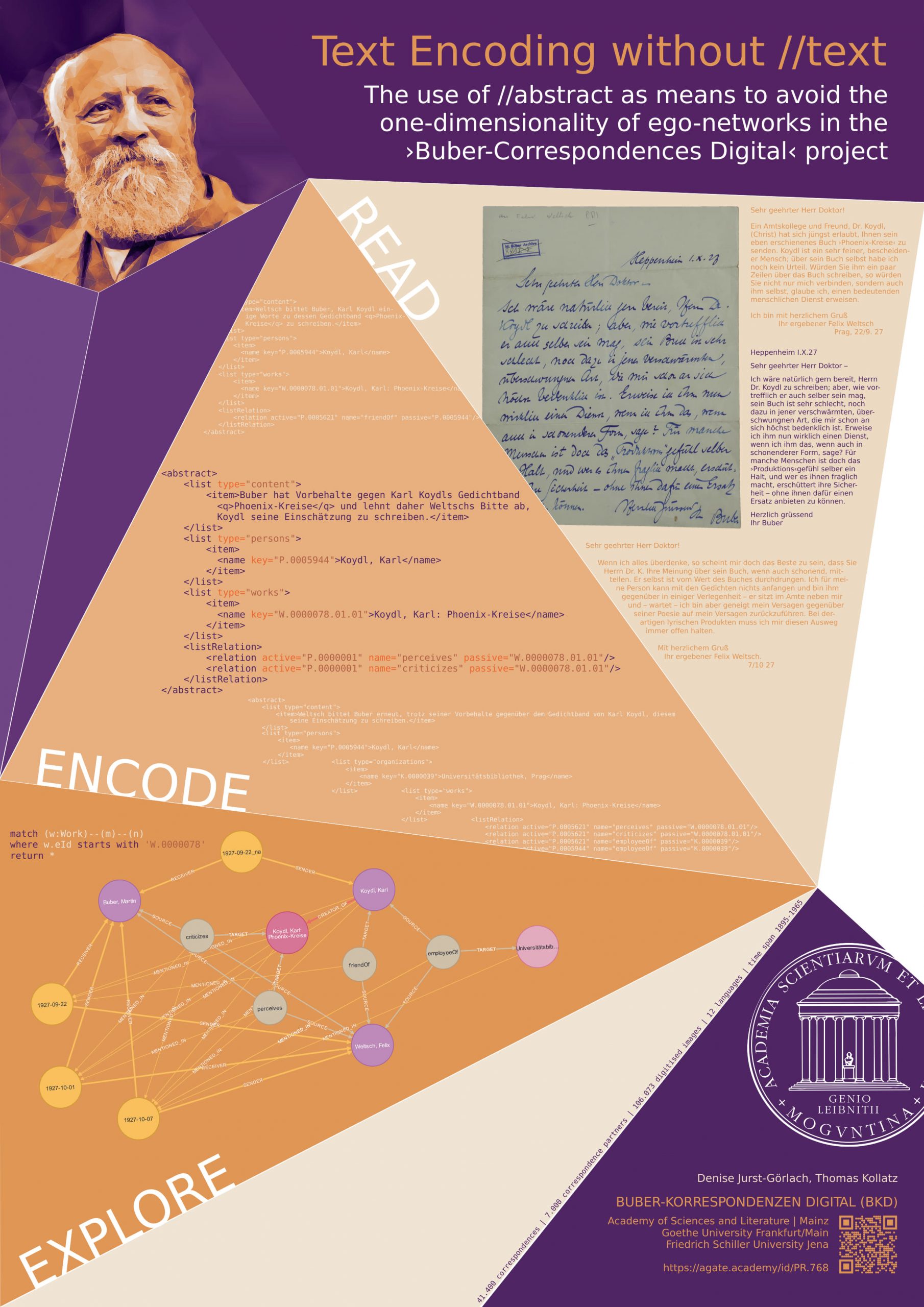
The key to exploring this corpus lies in structured data about the exchange of letters as well as on their contents. Buber Correspondence Digital (BKD) therefore does not merely identify mentions of people, organizations, places, works, and events in individual letters. It also links these references to one another using a vocabulary developed specifically to model selected thematic areas.The resulting relational entity model generates statements such as »a person attends an event«, »an event takes place at a location«, »a person engages with a work«, or »Person A and Person B are friends«.The relations recorded in the model focus on the development of personal, political, and business relationships and on tracing information flows and processes of publication and reception.
In accordance with Linked Open Data (LOD) principles, all entities are actively curated and linked , wherever possible, to external authority records and identifiers from GND, Wikidata and GeoNames. The resulting knowledge graphs provide the basis for digital network analyses both within and beyond the project.
Chaim Weizmann to Martin Buber, 27 December 1903
Nun, lieber Martin, ruhig Blut, wir haben nichts zu verlieren und nur zu gewinnen. Schreibe sofort.
Cataloging Categories
The Modular Edition
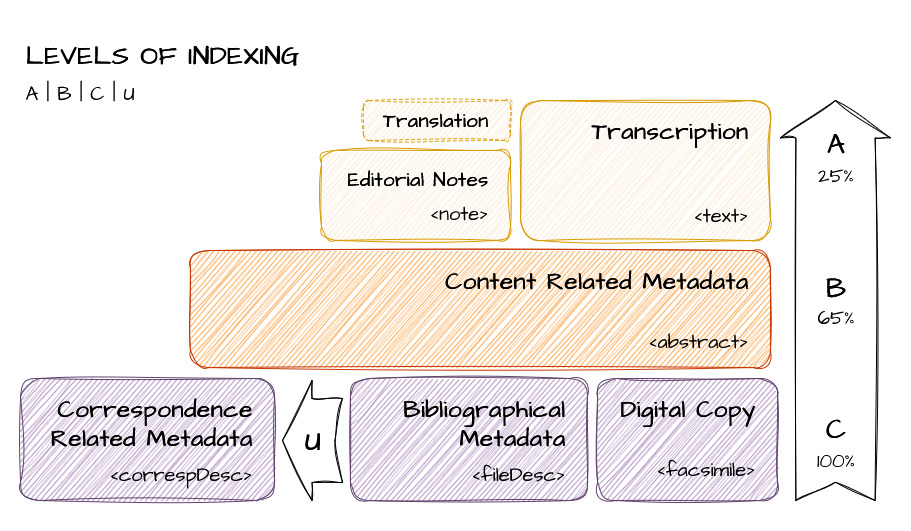
BKD aims to reconstruct Martin Buber’s extensive correspondence network as fully as possible and make it available for research.To this end, individual letters receive different levels of editorial treatment, ranging from the recording of bibliographic metadata alone — as in the case of large parts of Buber’s extensive correspondence with publishers — to critical transcription accompanied by commentary on specific passages for correspondence of particular significance in terms of both content and historical context.
Category A
Complete edition with a critical transcription and a reading version, as well as passage-level and overview commentaries, for particularly relevant correspondence
Category B
Detailed description of the content using an editorial summary and indexes of people, organizations, places, works, events, and keywords, linking these entities to one another through defined relations
Category C
Structured recording of bibliographic metadata on the sender, recipient, date, place, material characteristics, and any enclosures
Category U
Reconstruction of letters that have not survived but are attested by external sources, based on recorded dates of dispatch and receipt
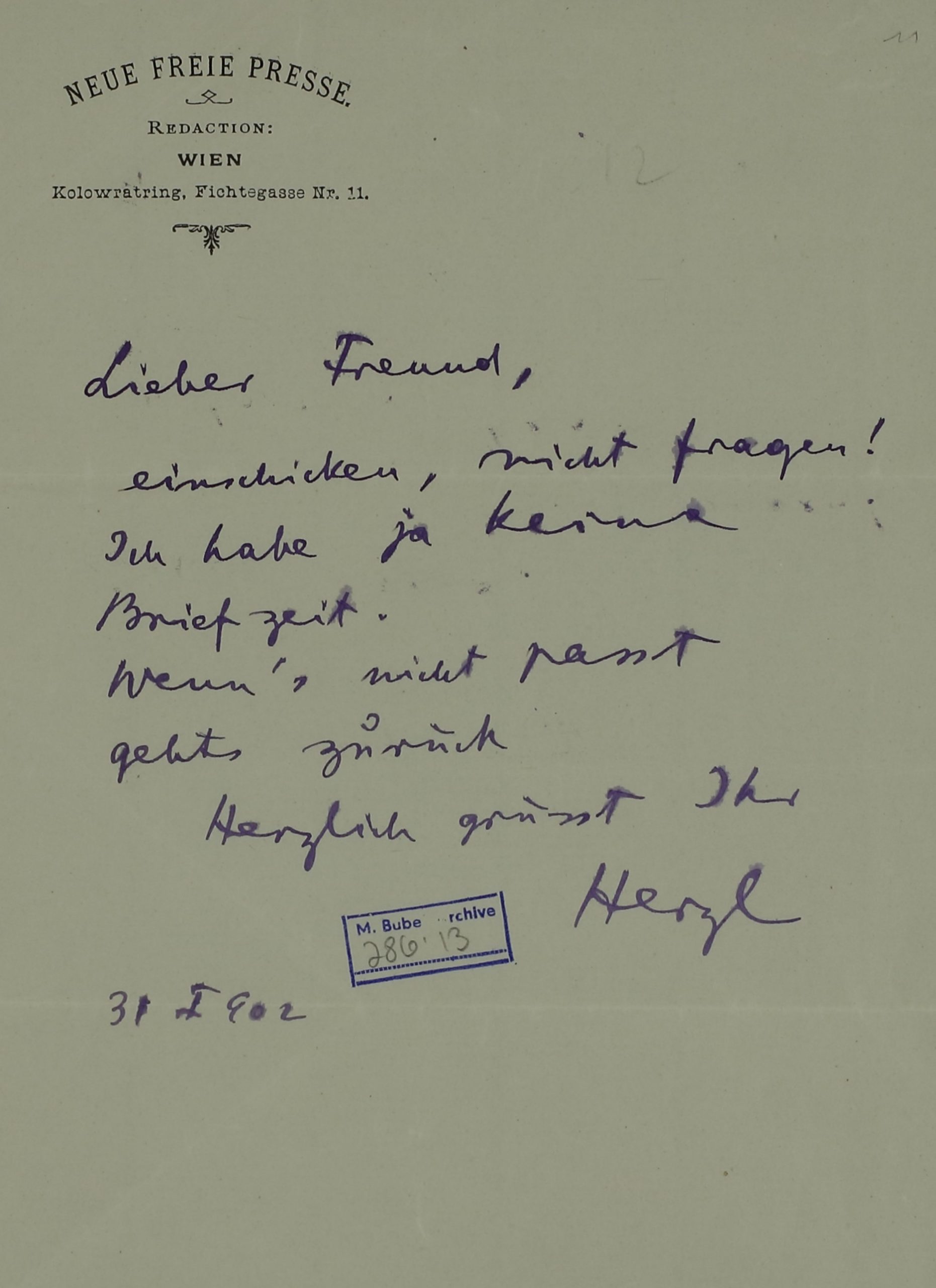
Theodor Herzl to Martin Buber, 31 January 1902
Lieber Freund, einschicken, nicht fragen! Ich habe ja keine Briefzeit.
encoding
Implementation in XML/TEI
BKD conducts its editorial work in accordance with the guidelines of the Text Encoding Initiative (TEI). All levels of metadata are consistently implemented in XML/TEI and can therefore be transferred from one category to another.
BKD Components
Correspondence-Related Metadata
<correspDesc ref="https://lod.academy/bkd/id/BKD02512.19020131.01.R">
  <correspAction type="sent">
    <persName key="P.0002131">Herzl, Theodor</persName>
    <orgName key="K.0000006">Neue Freie Presse (Redaktion)</orgName>
    <placeName key="O.0000007">Wien</placeName>
    <date when="1902-01-31"/>
  </correspAction>
  <correspAction type="received">
    <persName key="P.0000001">Buber, Martin</persName>
    <placeName key="O.0000007" evidence="conjecture">Wien</placeName>
  </correspAction>
</correspDesc>
Bibliographic Metadata
<fileDesc>
  <titleStmt>
    <title level="project">Buber-Korrespondenzen Digital</title>
    <title level="correspondence" n="BKD02512">Herzl, Theodor</title>
    <title level="unit" type="A">Theodor Herzl an Martin Buber, 31. Januar 1902</title>
    <title level="module" n="6" type="main">Literatur – Kunst – Theater</title>
    [...]
  <sourceDesc rend="original">
    <msDesc rend="autograph" status="sent">
      <msIdentifier>
        <country ref="https://www.geonames.org/294640">Israel</country>
        <settlement ref="https://www.geonames.org/281184">Jerusalem</settlement>
        <institution ref="https://d-nb.info/gnd/106122161X">The National Library of Israel</institution>
        <repository ref="https://www.nli.org.il/en/archives/NNL_ARCHIVE_AL990026183870205171/NLI">Martin Buber Archive</repository>
        <idno type="shelfmark">ARC. Ms. Var. 350 008 286</idno>
        <idno type="barcode">3014473-10</idno>
        <idno type="URI">https://www.nli.org.il/en/archives/NNL_ARCHIVE_AL990030144730205171</idno>
      </msIdentifier>
      <physDesc>
        <objectDesc>
          <supportDesc>
            <support>
              <objectType ref="https://d-nb.info/gnd/4008240-4">Brief</objectType>
            </support>
            <extent>
              <measure unit="sheets" quantity="1"/>
              <measure unit="pages" quantity="1"/>
              <measure unit="envelope" quantity="0"/>
            </extent>
          </supportDesc>
          <layoutDesc>
            <layout>
              <objectType rend="handwritten">Manuskript</objectType>
              <objectType corresp="K.0000006">Briefpapier</objectType>
            </layout>
          </layoutDesc>
        </objectDesc>
      </physDesc>
      <additional>
        <listBibl>
          <bibl>
            <title sameAs="https://www.zotero.org/groups/2922775/items/9PRSIYSI">Herzl, Briefe und Tagebücher 6</title>
            <biblScope unit="letter">3751</biblScope>
            <biblScope unit="page">421</biblScope>
          </bibl>
          <bibl>
            <title sameAs="https://www.zotero.org/groups/2922775/items/NKF9IFUP">Buber-Briefwechsel I</title>
            <biblScope unit="letter">33</biblScope>
            <biblScope unit="page">171</biblScope>
          </bibl>
        </listBibl>
      </additional>
    </msDesc>
  </sourceDesc>
</fileDesc>
[...]
   <handNotes n="1">
     <handNote scope="sole" scribe="P.0002131" rend="latintype">Herzl, Theodor</handNote>
   </handNotes>
   <langUsage>
     <language ident="de" scope="sole">Deutsch</language>
   </langUsage>
Digital Copy
<facsimile>
  <graphic xml:id="scan_3014473-10_0018" url="https://seafile.rlp.net/lib/ea8ec06e-09c7-4d6e-96df-6b195b34b2f8/file/NLI/350/3014473-10/3014473-10_0018.jpg" n="1"/>
</facsimile>
Content-Related Metadata
<abstract>
  <list type="content">
    <item>Herzl fordert Buber zum Einschicken von Manuskripten auf.</item>
  </list>
  <list type="works">
    <item>
      <name key="W.0000002.01" evidence="implicit">Neue Freie Presse</name>
    </item>
  </list>
  <listRelation>
    <relation active="P.0000001" name="contributorTo" passive="W.0000002.01" type="suggested"/>
  </listRelation>
</abstract>
Transcription
<text>
  <body>
    <div type="content" xml:lang="de">
      <pb n="1" facs="#scan_3014473-10_0018"/>
      <opener>
        <salute>Lieber Freund,</salute>
      </opener>
      <p>einschicken, nicht fragen! <lb/>Ich habe ja keine <lb/>Briefzeit.</p>
      <p>Wenn’s nicht passt <lb/>gehts zurück<supplied>.</supplied></p>
      <closer>
        <salute>Herzlich grüsst </salute>
        <signed rend="inline">Ihr <lb/>Herzl</signed>
        <dateline><date when="1902-01-31">31 I 902</date></dateline>
      </closer>
    </div>
  </body>
</text>
Buber Correspondence Digital Edition
Editing Guidelines and Schema
The complete editorial guidelines and ODD schema are available via the GitLab research data repository. Both are living documents that will continue to evolve throughout the project.